Could you introduce yourself?
Hello, I’m Cacol, a travel sketch artist. My real name is Se-hwan Lim.

When did you first start doing this kind of work?
I started making art professionally while I was in college. I’ve always preferred drawing by hand, and I’ve always loved traveling. Ever since I was young, I was drawn to the idea of sketching while traveling. You know those artists you see drawing on the street, especially in Europe? I wanted to do something like that.
But I worried about whether I could make a living that way, so I decided to study design. At the time, I focused more on travel than on drawing. I created travel content and wrote blog posts. I think I entered just about every travel-related competition I could find. One thing that worked in my favor was that hardly anyone else was submitting drawings.
A lot of travel content follows a similar format: people visit a destination, explore, do a few activities, and take photos. Because my content included drawings, it stood out visually, and the organizers found it interesting. Through those opportunities, I traveled to Germany with support from a scholarship foundation. I also joined Jeju Air’s college student ambassador program, which supported my travels so I could create content and help promote the airline.
Around that time, a new Star Wars movie was being made, and Disney held its first competition in Korea. Since I had already been making content about travel and drawing, I thought, “Why not combine them?” Back then, I thought a lot about bringing existing ideas together. Creating something completely new felt difficult. Sometimes I had an idea, but my drawing skills couldn’t quite keep up with it.
Then I thought: since Star Wars was coming to Korea, why not draw one of its most recognizable figures—a stormtrooper—traveling around the country? I set up a camera, tried making a time-lapse video for the first time, and submitted the drawing and video.
Later, I got a message inviting me to the awards ceremony. No one told me I had won the grand prize, so I just thought, “Well, I must have won something.” When I got there, it turned out I had won the grand prize in the art category.
That was when commissions started coming in. For most of those projects, I would film myself drawing, edit the footage, and deliver the video along with the artwork. I worked on collaborations for the Avengers, Beauty and the Beast, The Jungle Book, Star Wars, and other films.

What led you to fully commit to life as an artist?
I had to figure out how to make a living from drawing. In the early years of college, everyone is still wondering what they’ll do for a living, right? Since I wasn’t a painting major, I didn’t know how galleries worked or how to sell artwork. Most of my friends studied visual communication design and were heading into company jobs, so I didn’t really have anyone to ask.
I thought, “Maybe I could start by teaching drawing.” Using my Disney experience as a credential, I sent proposals to department store cultural centers—places that offer classes to the public—and other venues that seemed suitable. At the time, “travel sketching” wasn’t really an established class category, so the cultural centers were interested, and I started teaching.
I began earning money by teaching at different locations. At my busiest, I had as many as 12 classes a week. Sometimes I would teach at three places in a single day. I didn’t have a car, so I was constantly going back and forth on the subway, traveling to Seoul, Suwon, Incheon, and Cheonan.
I actually enjoyed that part, too. Each area gave me new places to discover. I could arrive early and spend some time drawing before class.
I was in my twenties then, wondering whether I could really support myself this way or whether I should get a company job. Meanwhile, even my youngest students were in their thirties, and most were in their forties, fifties, or older. We talked a lot about life and the things we were worried about.
Many of them were worried about leaving their jobs and not knowing how they would make a living afterward. As someone in my twenties, what advice could I possibly give them? But listening to them made me think.
I realized, “Maybe a company job isn’t the path for me after all.” If so many people were worried about leaving their jobs—even in their thirties—and figuring out what came next, I felt I should build a stronger foundation for what I was already doing. If it didn’t work out, I could take a part-time job at 30 or find some other way to get by.

So, while teaching, I started posting my drawings on Instagram. I already had a blog, but Instagram felt more casual and seemed like a good place to share my art. I kept posting drawings, including work featuring different places and neighborhoods.
Because people in other countries could see my work on Instagram, commissions started coming in from abroad, too. I also began getting opportunities to work on books.
I think I’ve done just about every kind of drawing-related job: café murals, food illustrations, book covers, promotional images, and live drawing. I’m still doing all of that today.
That was a long answer, wasn’t it? [Laughs.]

It sounds like there must have been plenty of challenges along the way.
The income isn’t always great. At first, I was more focused on getting better at promotion and marketing than on drawing itself. I knew there were so many people around me who could draw incredibly well, but most of them focused entirely on making art. I felt I couldn’t match their drawing skills, so I asked myself, “What else can I offer?”
I decided to put myself out there. I wrote proposals saying, “This is the kind of artist I am, and this is what I’d like to create with you,” and sent them to different organizations and businesses.
Fortunately, most responded positively. They needed creative work for their own projects, too. When I reached out first with an idea, even if it didn’t happen right away, it often led to work later on. That’s how I earned most of my income: through commissioned illustration and promotional projects rather than selling original artwork.
As for original pieces, I usually sell them when someone contacts me through a direct message or when I have an exhibition. Still, I’ve often wished there were a place where I could sell my work consistently.
Some people want to see the artwork in person, but it’s often difficult to arrange that. Shipping is another concern. Since I pack and send the work myself, I worry about the glass in the frames breaking, so I usually ship the artwork without a frame.
Are there particular things that inspire you?
I tend to believe there’s something to learn from everything, and that anything can connect to drawing in some way. But I do think I learn a great deal when I travel.
Would you like people who buy your work to feel what you felt when you visited those places?
Ideally, yes. But I can’t insist that they experience it the same way I did. Everyone is looking for something different.
What I personally want to capture is the particular atmosphere of a destination or a space: the breeze against my skin, the scents, or the sound of people passing by. I want to hold those things in a drawing.
That’s why I once wanted to put on an exhibition of my sketchbooks. Drawings made right there, while traveling, hold that immediate experience in a way that feels complete.
But exhibiting sketchbooks is difficult. If you want to frame the drawings, you have to take the sketchbooks apart, and then you lose the feeling of the sketchbook itself. If you leave them intact and let visitors turn the pages, they can get damaged very quickly.
What I’d like to do in the future is create an experience where turning a page in a sketchbook brings a sound or a scent with it. If I have recordings from the place, I could play those, too. I want to make travel-related artwork that lets people experience a place indirectly through more than just the image.
It sounds like a big part of your work is conveying what it feels like to be in a place.
Yes, although there aren’t that many artists who make travel drawings as part of their own personal practice. When a drawing depicts a specific place, people are often less likely to buy it unless they have their own memories of being there.
That’s one reason I make different kinds of work. When it comes to buying, people seem to prefer my drawings filled with lots of different people. Maybe they feel as though they’re part of that crowd. I think those pieces also work well when displayed on a wall.
Have any visitors or responses to your exhibitions stayed with you?
I’m careful about approaching people while they’re looking at the work, because asking them questions might make them feel put on the spot. Unless they choose to tell me what they think, I generally leave them to look.
When I draw a particular destination, the people who have traveled there themselves tend to take a greater interest.
Some people think I’m an artist who only draws cups. Others think I only draw people, and others think I only draw travel scenes. They seem to fall into those three groups. Isn’t that interesting?
Each person gets drawn to a particular part of my work. People who like the cup drawings talk about cafés, cups, or how much they enjoy the colors. People who spend a long time looking often focus on the drawings of people. Those works can feel different depending on the space where they’re displayed, and some viewers especially enjoy exploring all the little details.
I also show videos alongside my drawings. Maybe watching the process makes it look easy, because quite a few people try it themselves. Sometimes they send me a DM with their unsuccessful attempt and say, “I can’t get it to work!” [Laughs.]
You must have tried a variety of brushes and pens to achieve those details and subtle effects.
[Carcol takes out a bag to show us. “This is my travel kit!”]
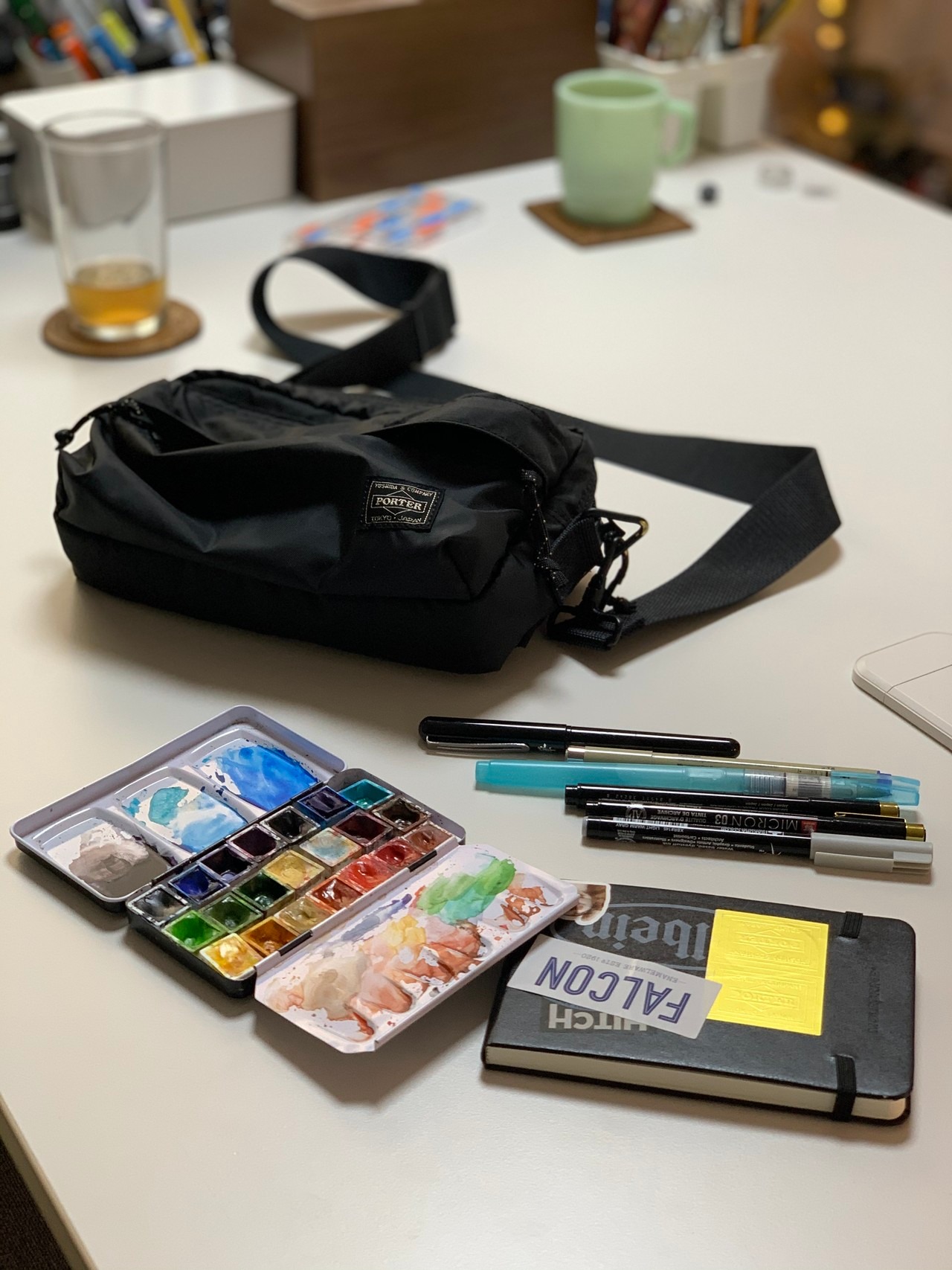
Everything needs to be practical for traveling, so I keep my pencil case small. If I need to carry more, I use a backpack.
Whether I’m painting a large sky or a small one, I use these same tools. I don’t really use large brushes or other bulky equipment. I think carrying this kit around has made me so familiar with it that I naturally keep using it.
I want to be able to draw wherever I go. This isn’t a fancy brush, but you can fill the handle with water and use it that way. I carry some basic pens, too. For me, tools that are easy to carry are the best choice.
Are there any kinds of work or styles you’d love to try? Or anyone you’d like to collaborate with?
I’d like to make drawings completely filled with people. I’d also like to work with fabric, create products, and try things with more color. I’d love to design phone cases, too. There are so many things!
Still, what matters most to me is becoming as good as I can at travel sketching. I’d like to publish books, and one day I’d love to collaborate with Louis Vuitton.
It’s not because Louis Vuitton is a luxury brand. It’s because they produce art books, and I’d love to work on one of those—a volume about Korea. I tried looking for a way to send them a proposal, but I couldn’t find the right contact. [Laughs.]
I’d also like to collaborate with Starbucks. I want to do something with drawing on Starbucks napkins. So many napkins get thrown away, and I thought there might be an environmental idea in encouraging people to draw on a napkin they’ve used instead of discarding it, turning it into a little artwork they can treasure. I even contacted Starbucks customer service and sent them the proposal.
Ultimately, my goal is to spend a month or two traveling through a region, turn that experience into a book, sell it, and then move on to another place. I’d love to travel around the world and create an illustrated collection of places across it.
I’d also like to make a book devoted entirely to great places to eat. I think I’m drawn to anything that lets me explore and create something connected to the places I visit. I’d love to interview the different people who live there, too, or make an illustrated book featuring only long-established local restaurants and shops.
If you hadn’t become a travel sketch artist, what do you think you would be doing?
Most people around me say I would have gone into advertising or marketing. [Laughs.] I think that makes sense, since I’m very interested in video and advertising.
Otherwise, I might have opened a restaurant. I love drawing, but I also love cooking.
Cooking helps me draw food, too, because I understand how it’s made. It even changes the way I use color.
For example, when you bake bread, the dough starts out pale, and an egg wash helps the surface develop that beautiful golden-brown color as it bakes. That understanding carries over into my drawing: I add the color of the egg wash, then gradually build up the colors that suggest the bread browning in the oven.
So I think I probably would have ended up doing something with food.

Could you introduce yourself?
Hello, I’m Cacol, a travel sketch artist. My real name is Se-hwan Lim.
When did you first start doing this kind of work?
I started making art professionally while I was in college. I’ve always preferred drawing by hand, and I’ve always loved traveling. Ever since I was young, I was drawn to the idea of sketching while traveling. You know those artists you see drawing on the street, especially in Europe? I wanted to do something like that.
But I worried about whether I could make a living that way, so I decided to study design. At the time, I focused more on travel than on drawing. I created travel content and wrote blog posts. I think I entered just about every travel-related competition I could find. One thing that worked in my favor was that hardly anyone else was submitting drawings.
A lot of travel content follows a similar format: people visit a destination, explore, do a few activities, and take photos. Because my content included drawings, it stood out visually, and the organizers found it interesting. Through those opportunities, I traveled to Germany with support from a scholarship foundation. I also joined Jeju Air’s college student ambassador program, which supported my travels so I could create content and help promote the airline.
Around that time, a new Star Wars movie was being made, and Disney held its first competition in Korea. Since I had already been making content about travel and drawing, I thought, “Why not combine them?” Back then, I thought a lot about bringing existing ideas together. Creating something completely new felt difficult. Sometimes I had an idea, but my drawing skills couldn’t quite keep up with it.
Then I thought: since Star Wars was coming to Korea, why not draw one of its most recognizable figures—a stormtrooper—traveling around the country? I set up a camera, tried making a time-lapse video for the first time, and submitted the drawing and video.
Later, I got a message inviting me to the awards ceremony. No one told me I had won the grand prize, so I just thought, “Well, I must have won something.” When I got there, it turned out I had won the grand prize in the art category.
That was when commissions started coming in. For most of those projects, I would film myself drawing, edit the footage, and deliver the video along with the artwork. I worked on collaborations for the Avengers, Beauty and the Beast, The Jungle Book, Star Wars, and other films.
What led you to fully commit to life as an artist?
I had to figure out how to make a living from drawing. In the early years of college, everyone is still wondering what they’ll do for a living, right? Since I wasn’t a painting major, I didn’t know how galleries worked or how to sell artwork. Most of my friends studied visual communication design and were heading into company jobs, so I didn’t really have anyone to ask.
I thought, “Maybe I could start by teaching drawing.” Using my Disney experience as a credential, I sent proposals to department store cultural centers—places that offer classes to the public—and other venues that seemed suitable. At the time, “travel sketching” wasn’t really an established class category, so the cultural centers were interested, and I started teaching.
I began earning money by teaching at different locations. At my busiest, I had as many as 12 classes a week. Sometimes I would teach at three places in a single day. I didn’t have a car, so I was constantly going back and forth on the subway, traveling to Seoul, Suwon, Incheon, and Cheonan.
I actually enjoyed that part, too. Each area gave me new places to discover. I could arrive early and spend some time drawing before class.
I was in my twenties then, wondering whether I could really support myself this way or whether I should get a company job. Meanwhile, even my youngest students were in their thirties, and most were in their forties, fifties, or older. We talked a lot about life and the things we were worried about.
Many of them were worried about leaving their jobs and not knowing how they would make a living afterward. As someone in my twenties, what advice could I possibly give them? But listening to them made me think.
I realized, “Maybe a company job isn’t the path for me after all.” If so many people were worried about leaving their jobs—even in their thirties—and figuring out what came next, I felt I should build a stronger foundation for what I was already doing. If it didn’t work out, I could take a part-time job at 30 or find some other way to get by.
So, while teaching, I started posting my drawings on Instagram. I already had a blog, but Instagram felt more casual and seemed like a good place to share my art. I kept posting drawings, including work featuring different places and neighborhoods.
Because people in other countries could see my work on Instagram, commissions started coming in from abroad, too. I also began getting opportunities to work on books.
I think I’ve done just about every kind of drawing-related job: café murals, food illustrations, book covers, promotional images, and live drawing. I’m still doing all of that today.
That was a long answer, wasn’t it? [Laughs.]
It sounds like there must have been plenty of challenges along the way.
The income isn’t always great. At first, I was more focused on getting better at promotion and marketing than on drawing itself. I knew there were so many people around me who could draw incredibly well, but most of them focused entirely on making art. I felt I couldn’t match their drawing skills, so I asked myself, “What else can I offer?”
I decided to put myself out there. I wrote proposals saying, “This is the kind of artist I am, and this is what I’d like to create with you,” and sent them to different organizations and businesses.
Fortunately, most responded positively. They needed creative work for their own projects, too. When I reached out first with an idea, even if it didn’t happen right away, it often led to work later on. That’s how I earned most of my income: through commissioned illustration and promotional projects rather than selling original artwork.
As for original pieces, I usually sell them when someone contacts me through a direct message or when I have an exhibition. Still, I’ve often wished there were a place where I could sell my work consistently.
Some people want to see the artwork in person, but it’s often difficult to arrange that. Shipping is another concern. Since I pack and send the work myself, I worry about the glass in the frames breaking, so I usually ship the artwork without a frame.
Are there particular things that inspire you?
I tend to believe there’s something to learn from everything, and that anything can connect to drawing in some way. But I do think I learn a great deal when I travel.
Would you like people who buy your work to feel what you felt when you visited those places?
Ideally, yes. But I can’t insist that they experience it the same way I did. Everyone is looking for something different.
What I personally want to capture is the particular atmosphere of a destination or a space: the breeze against my skin, the scents, or the sound of people passing by. I want to hold those things in a drawing.
That’s why I once wanted to put on an exhibition of my sketchbooks. Drawings made right there, while traveling, hold that immediate experience in a way that feels complete.
But exhibiting sketchbooks is difficult. If you want to frame the drawings, you have to take the sketchbooks apart, and then you lose the feeling of the sketchbook itself. If you leave them intact and let visitors turn the pages, they can get damaged very quickly.
What I’d like to do in the future is create an experience where turning a page in a sketchbook brings a sound or a scent with it. If I have recordings from the place, I could play those, too. I want to make travel-related artwork that lets people experience a place indirectly through more than just the image.
It sounds like a big part of your work is conveying what it feels like to be in a place.
Yes, although there aren’t that many artists who make travel drawings as part of their own personal practice. When a drawing depicts a specific place, people are often less likely to buy it unless they have their own memories of being there.
That’s one reason I make different kinds of work. When it comes to buying, people seem to prefer my drawings filled with lots of different people. Maybe they feel as though they’re part of that crowd. I think those pieces also work well when displayed on a wall.
Have any visitors or responses to your exhibitions stayed with you?
I’m careful about approaching people while they’re looking at the work, because asking them questions might make them feel put on the spot. Unless they choose to tell me what they think, I generally leave them to look.
When I draw a particular destination, the people who have traveled there themselves tend to take a greater interest.
Some people think I’m an artist who only draws cups. Others think I only draw people, and others think I only draw travel scenes. They seem to fall into those three groups. Isn’t that interesting?
Each person gets drawn to a particular part of my work. People who like the cup drawings talk about cafés, cups, or how much they enjoy the colors. People who spend a long time looking often focus on the drawings of people. Those works can feel different depending on the space where they’re displayed, and some viewers especially enjoy exploring all the little details.
I also show videos alongside my drawings. Maybe watching the process makes it look easy, because quite a few people try it themselves. Sometimes they send me a DM with their unsuccessful attempt and say, “I can’t get it to work!” [Laughs.]
You must have tried a variety of brushes and pens to achieve those details and subtle effects.
[Carcol takes out a bag to show us. “This is my travel kit!”]
Everything needs to be practical for traveling, so I keep my pencil case small. If I need to carry more, I use a backpack.
Whether I’m painting a large sky or a small one, I use these same tools. I don’t really use large brushes or other bulky equipment. I think carrying this kit around has made me so familiar with it that I naturally keep using it.
I want to be able to draw wherever I go. This isn’t a fancy brush, but you can fill the handle with water and use it that way. I carry some basic pens, too. For me, tools that are easy to carry are the best choice.
Are there any kinds of work or styles you’d love to try? Or anyone you’d like to collaborate with?
I’d like to make drawings completely filled with people. I’d also like to work with fabric, create products, and try things with more color. I’d love to design phone cases, too. There are so many things!
Still, what matters most to me is becoming as good as I can at travel sketching. I’d like to publish books, and one day I’d love to collaborate with Louis Vuitton.
It’s not because Louis Vuitton is a luxury brand. It’s because they produce art books, and I’d love to work on one of those—a volume about Korea. I tried looking for a way to send them a proposal, but I couldn’t find the right contact. [Laughs.]
I’d also like to collaborate with Starbucks. I want to do something with drawing on Starbucks napkins. So many napkins get thrown away, and I thought there might be an environmental idea in encouraging people to draw on a napkin they’ve used instead of discarding it, turning it into a little artwork they can treasure. I even contacted Starbucks customer service and sent them the proposal.
Ultimately, my goal is to spend a month or two traveling through a region, turn that experience into a book, sell it, and then move on to another place. I’d love to travel around the world and create an illustrated collection of places across it.
I’d also like to make a book devoted entirely to great places to eat. I think I’m drawn to anything that lets me explore and create something connected to the places I visit. I’d love to interview the different people who live there, too, or make an illustrated book featuring only long-established local restaurants and shops.
If you hadn’t become a travel sketch artist, what do you think you would be doing?
Most people around me say I would have gone into advertising or marketing. [Laughs.] I think that makes sense, since I’m very interested in video and advertising.
Otherwise, I might have opened a restaurant. I love drawing, but I also love cooking.
Cooking helps me draw food, too, because I understand how it’s made. It even changes the way I use color.
For example, when you bake bread, the dough starts out pale, and an egg wash helps the surface develop that beautiful golden-brown color as it bakes. That understanding carries over into my drawing: I add the color of the egg wash, then gradually build up the colors that suggest the bread browning in the oven.
So I think I probably would have ended up doing something with food.